
Wayback Machine. Internet Archive.
2026 Preface: why I initially wrote this origin story.
This article was specifically written for Michaela A. Parnell/ ‘HS Action Together’, for presentations made in 2019 at Blastfest & the Science in Public conference, in Manchester, UK.
My first contribution for Michaela is here.
That contribution is also contained here.
2026 Preface: Dessau definition of HS co-authored by Michelle Barlow & Robert Howes.
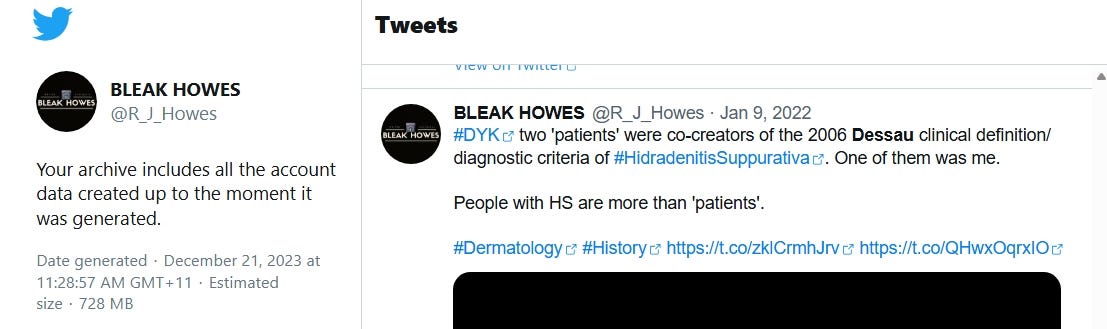
To conclude this preface, I recall an anecdote which may explain both my value to the contemporaneous medical/people with HS community and may also explain my ‘dangerousness’, to that same community. I have recited this anecdote on social media in the past, notably on Twitter/X and Facebook. Today I recite this in a more contextually correct manner; people with HS mattered in the beginning of this medical research foundation.
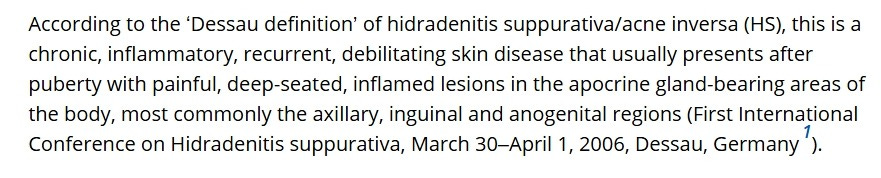
Both Michelle Barlow and I had a long wish list in 2004 (well before foundation) for Hidradenitis Suppurativa which included a globally recognised consensus definition of HS. Much of what we wanted (e.g. HS cure) was achievable, with sustained medical research that would need to span years or decades.
Michelle was, among other things, a pragmatic realist. Before she flew to Germany in 2006, we had agreed that the minimum that her and I and all people with HS need, is one definition of the disease that’s used globally.
It did not have to stand the test of time, it could be modified in the future, it just had to be a beginning for doctors to take HS seriously. Michelle and I, disclosed our need to our fellow co-founders, Dr’s Ralf Paus and Christos Zouboulis, and they agreed it was a ‘must have’ outcome of the symposium. Neither Michelle nor I were happy with the inclusion of terminology like ‘Acne Inversa’, but we felt the process of consensus must begin somewhere, it must begin with us four co-founders, and thus, with great reserve, Michelle and I deferred to our medical co-founders on that point.
Our draft appears here:
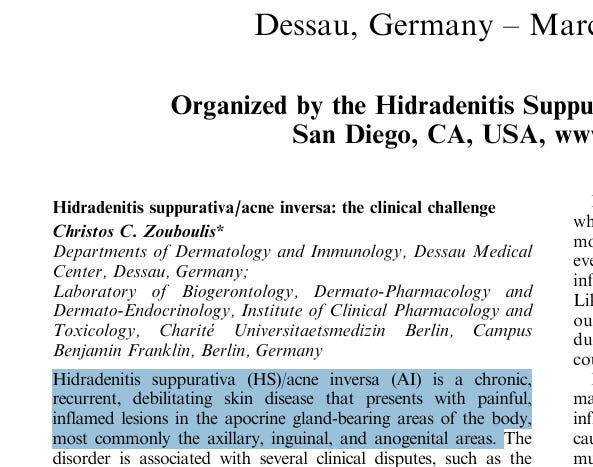
When Michelle returned to San Diego after the Dessau meeting, I asked her about the consensus definition. In their absolute excitement, they simply forgot. So, in the aftermath of Dessau 2006, Michelle, Ralf, Christos and I drafted a document for attendees to sign. The “post-Dessauer” definition of Hidradenitis Suppurativa thus, is co-authored by two people with Hidradenitis Suppurativa; a contemporary and inconvenient HS Truth.
ORIGIN STORY
‘We have to get something started’: - A social history of the origin of the HSF, Inc.(1). by RJ Howes (2), Melbourne, Victoria, Australia. March 5, 2019.
1. HSF Inc.’ San Diego, California, USA.
2. Co-creator, co-author and co-founder HS-Research dot com. 2005. Co-founder “Hidradenitis Suppurativa Foundation Inc.” (HSF, Inc). San Diego 2005. Former Vice-President, Secretary & Chief Financial Officer, HSF, Inc. 2005-2008. Creator: Personal HS Research Database. 2018 & Current Email: robertjameshowes@gmail.com
I met the future first President of the ‘Hidradenitis Suppurativa Foundation Inc.’ San Diego, (HSF Inc.) online in December 2003. We were members of the Yahoo Group ‘Hidradenitis’. At the time ‘Hidradenitis’ was the largest HS support community in the world. We had HS. What we did not have at that time was a grand plan for HS, much less a grand plan for our own lives. We simply wanted to know more about this disease we shared. We were looking for support and we found it in abundance on Yahoo.
On Yahoo ‘Hidradenitis’ that December, I responded to somebody else’s argument with the quote ‘I disagree with what you say but will defend to the death your right to say it’. Michelle Barlow, business owner and community leader of San Diego, California responded quickly to my comment. We quickly discovered in each other a shared respect and admiration for small ‘d’ democratic ideas, human rights & inclusiveness.
Over the next year and a half, both individually and together via email, Yahoo Instant Message and telephone, we dived into and trekked through and discovered for us, what the world knew about Hidradenitis Suppurativa. At the time I was working as a night manager of a hotel in Melbourne, Australia, so the time difference was hardly an issue between San Diego, where Michelle lived and worked.
Very early on we both came to the same conclusion that most doctors had arrived at since 1833, and the same conclusion that most people with HS coming together online had arrived at since 1996; not much is known. However, we tried to keep an open mind so that our assumptions were not the only thing driving us towards that hidden destination. There was no map. Our compass, guiding us through all things HS, was Michelle’s extraordinary intelligence, caring empathy and practical pragmatism; a very fortuitous combination for what was to become the future of HS research.
We divided our time over two primary issues; what do Doctors think and feel, and what do people with HS think and feel. Looking back, with only reason and emotion as a source, I estimate that greater than 98% of the doctors we wrote to in those 18 months responded to our requests for information, most of them rapidly, and most of them quite keen to discuss what they knew and what they did not know about HS.
HS-USA Inc. of Brighton Michigan, which was a nonprofit organisation for the benefit of people with HS in America, gave Michelle and I complete access to their HS patient survey data, which up to that point, had only been published online in summary form. Why did HS-USA do this for us? Because we had HS, we asked, and they provided; this is simply what nonprofits do.
Coupled with surveys from the HS patient associations HIDE-Canada and HIDE-France (now AFRH), the HS-USA patient surveys appeared to describe a very distinct group of people who share a very distinct disease. Both Michelle and I could see for ourselves that yes, we have HS and in spite of much disagreement between people with HS, there appear to be more similarities in our medical and social histories than differences.
We read and collated archived posts on Yahoo ‘Hidradenitis’ saving the data in a multitude of folders with titles such as ‘Med. Rx’, ‘Surg Rx’, ‘Patient Rx’ and ‘History HIDE’ as just a few examples. We also compared what people with HS experience to what Doctors described. There were certain things about HS that both doctors and patients seemed to agree upon; for instance, antibiotics seemed to help in the presence of infection, but not for everyday HS. However, there were disparities in other areas, such as the patients overall experience with isotretinoin for HS, and in fact, HS-USA, at the time, publicly advocated against the use of this drug for HS.
Sometime in 2004 Michelle said to me ‘We have to get something started’. I knew exactly what she meant. That ‘something’ we discussed at length. Hidradenitis Suppurativa, was a disease which had been ‘orphaned’ globally by governmental ignorance, incorrect or biased medical assumptions and also ‘orphaned’ globally by the inaction of advocacy groups such as the National Organization for Rare Disorders (USA). (Yahoo HS Support and HS-USA community leaders lobbied representatives from various congressional districts and to NORD itself with little response and no action taken).
In order for us to discover what that ‘something’ could look like to us, or what that ‘something’ may be to others, I left Australia for America. We collected our data, summarised it in articles and presented both the data and our analysis on a website called HS-Research dot com. Global response to our website was immediate and positive from all sides of the HS divide.
Michelle and I were in no doubt that HS required an organisation specifically focused on medical and scientific research. However, we vacillated for months. We attempted to involve the HS online support community in our decision-making process, and we attempted to lobby HS-USA to deliberately divide their attention to scientific and medical research as well as providing support and quality information about HS. Our combined efforts along these lines failed. With reluctance and sadness, yet with an entire world of excitement on our shoulders, we continued on.
One of many ways we tried to attract medical and scientific interest in HS on a global basis, was to brainstorm as many theories as to what HS ‘could’ be, then to read widely in the medical fields and locate expert opinions that could support these theories. We threw these questions into the global ether of interested doctors and scientists.
One of these theories prompted a rapid response from Dr Ralf Paus, Germany in June 2005. I don’t have the email now, but from memory it was along the lines ‘advances in the field of Hidradenitis Suppurativa is more likely to happen if there is a nonprofit organisation specifically devoted to researching the disease’. We may not have been fully conscious of this at the time, but we had been waiting patiently for skin experts to step up to the plate and volunteer without prompting.
We responded to Ralf just as fast, basically saying, yes we are in, are you? Ralf wrote something like of course, and you need to contact Dr. Christos Zouboulis (Germany) and get him on board. We did. Ralf asked us who else do we need on our Medical and Scientific Advisory Board, that was easy; we already had written a list of must-have doctors.
Once we decided that it would have to be us two with HS, to take this action into the world, sitting down together to write what this organisation would look like was not as difficult as we originally felt. Michelle found mentors in the rare disease community who assisted greatly in that respect.
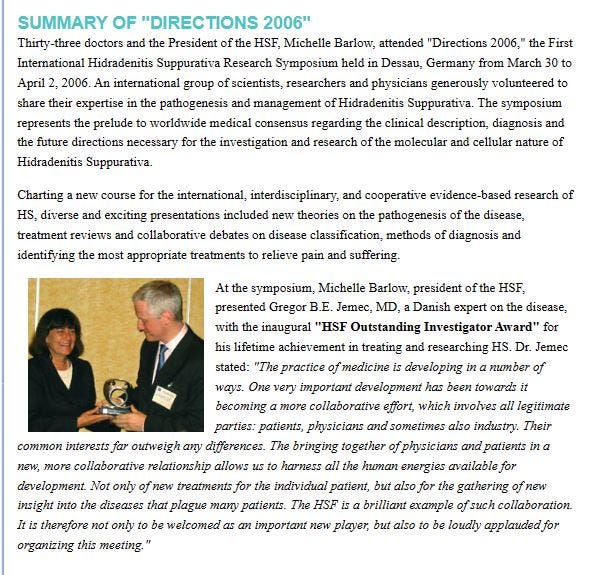
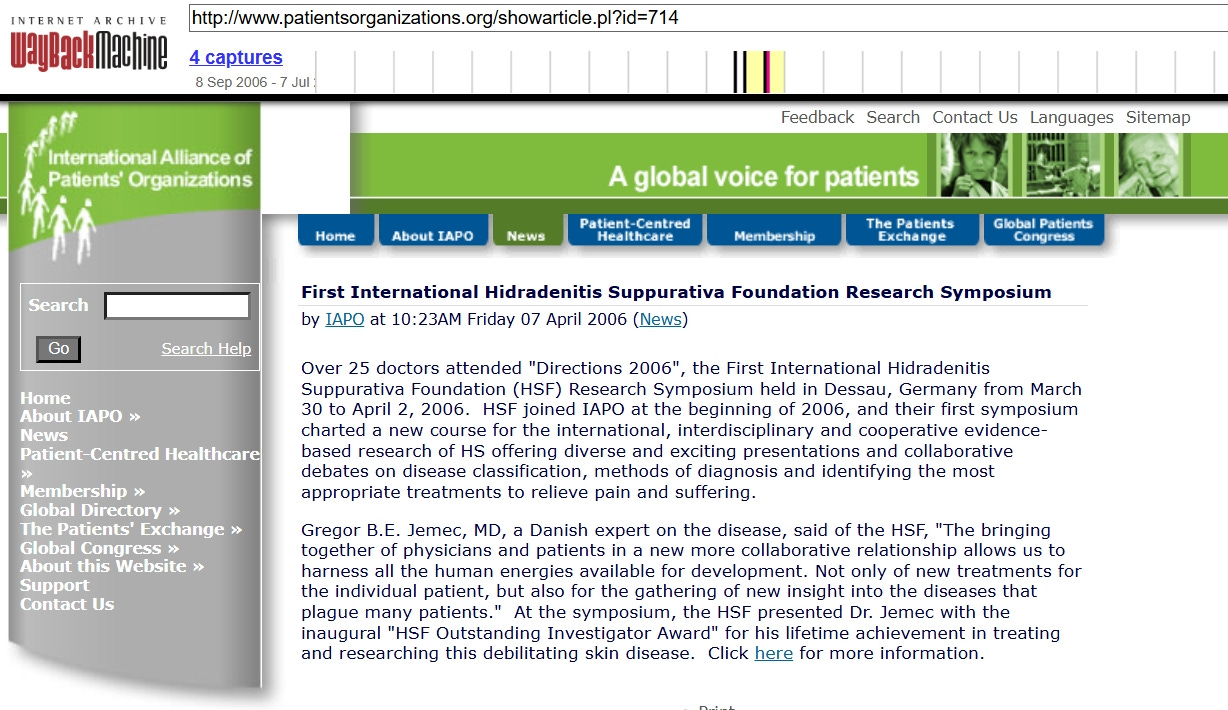
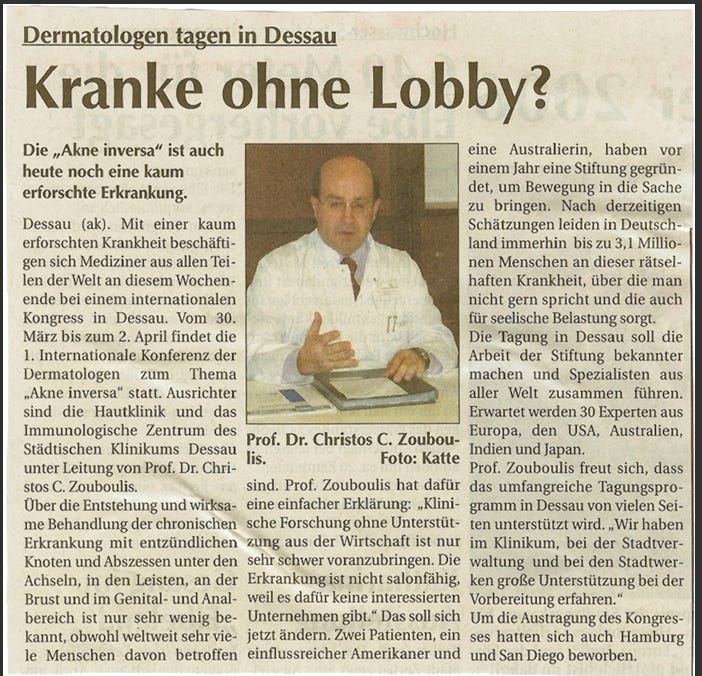
The First International HS Research SymposiumSo, what would this ‘something’ do in its first 12 months that could make the entire world notice Hidradenitis Suppurativa in a way it may never have been noticed before? For Michelle, Ralf, Christos and I, the answer was obvious: - bring these doctors & scientists together to talk about HS. From March 30th to April 2nd, 2006, the first international HS research symposium was held in Dessau, Germany.
The symposium was also known as ‘Directions2006: Developing a Global Roadmap for HS Research’. Once you find your own road, you have direction. Suddenly and to your absolute surprise and delight, you become your own cartographer. Don’t forget to leave a map behind. Others may follow.